#AskGlaston: Does the shard size of tempered glass vary depending on the impact strength?

Date: 15 October 2020
Copyright:
  • Antti Aronen | Glaston
  • https://www.glastory.net/askglaston-episode-57-does-the-shard-size-of-tempered-glass-vary-depending-on-the-impact-strength/

Date: 15 October 2020

It is a very known behavior that the glass fragmentation depends on where you break the glass.

This week, we’ve received the following question from Middle East:

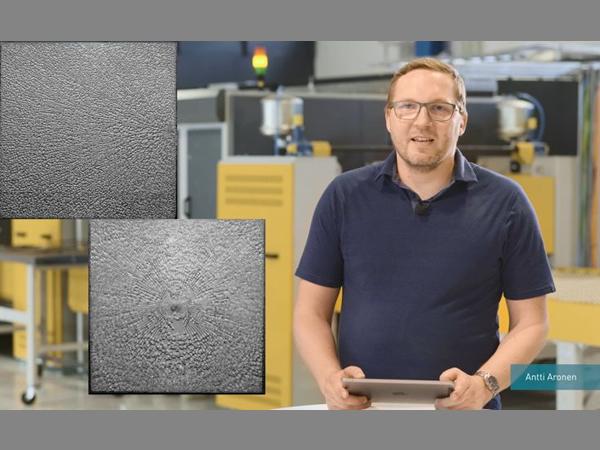
I have observed that when we break glass in the center with a lot of force, the fragments close to the point of impact are sometimes big long shards exceeding the standard of 40 fragments. However, shards further from the center of the impact are smaller in size. Is this normal or does this mean the glass is not tempered properly? Does the shard size vary depending on the strength of the impact?

And if this means our glass is not tempered properly, what can we do to rectify this?

It is a very known behavior that the glass fragmentation depends on where you break the glass. If you break the glass in the center, you can get long shards, but if you break it on the edges, then usually the fragments are smaller. And that’s because you have different boundary conditions depending on whether you break the glass in the center or on the edge.

If you want to get smaller fragments even if you break the glass in the center, you can increase the stress level by tempering the glass at a higher temperature and with the higher cooling power. Then, the size of the fragments will get smaller. 

#AskGlaston: Does the shard size of tempered glass vary depending on the impact strength?

#AskGlaston: Does the shard size of tempered glass vary depending on the impact strength?

600450 #AskGlaston: Does the shard size of tempered glass vary depending on the impact strength? glassonweb.com

Others also read

Latest on Glastory by Robert Jenks: Improving your performance for a lifetime - Smart strategies for glass processing line success (Part 2/2)
Smart glass, simplified. Meet OSSE, Organic Semiconductor Materials for Sustainable Electronics, from the University of Turku.
In Part 1 of the new Glastory blog series, the article explores how production uptime becomes a competitive advantage and which strategies help keep operations smooth and businesses strong.
In this seventh episode, we’re exploring how dynamic mixing enhances sealing quality and speed.
At Step Change 2025, ReViSalt demonstrated how its innovations are reshaping the future of glass strengthening.
In this sixth episode, the focus is on how to assemble and gas-fill IG units synchronously.

FROM INDUSTRY

Polígono Industrial El Bayo, parcela I, 19
24492 Cubillos del Sil León
Spain

ARTICLES RELATED PRODUCTS

Add new comment